Pages

Thursday, November 18, 2010

Iran's domestic air defense system is upgraded version of S-200 - media

S-300
10:01 18/11/2010
© RIA Novosti. Mikhail Fomichev
Iran's domestic air defense system reported to be an analogue of the Russian S-300 is a mere upgraded version of the obsolete Soviet-made S-200, Iran's Press TV website said referring to top military officials. The S-200 was officially accepted into service in 1967. Iran acquired several systems from the Soviet Union in the late 1980s. Today, the S-200 is considered obsolete in comparison with the S-300.
"We have developed the system by upgrading systems like the S-200 and we have tested it successfully using all our potential and experience in the Islamic Revolution Guards Corps (IRGC), the Army and the Defense Ministry," Brigadier General Mohammad Hassan Mansourian told Press TV on Wednesday.
The move came after Russia refused to fulfill an S-300 delivery contract in September, the general added.
Russia signed a deal to deliver five battalions of S-300PMU-1 air defense systems to Iran in 2007, but banned the sale in 2010, saying the systems, along with a number of other weapons, were covered by a fourth round of sanctions imposed by the UN Security Council against Iran over its nuclear program in June.
The advanced version of the S-300 missile system, called S-300PMU1, has a range of over 150 kilometers (over 100 miles) and can intercept ballistic missiles and aircraft at low and high altitudes, making it an effective tool for warding off possible air strikes.
MOSCOW, November 18 (RIA Novosti)

RIA NOVOSTI

Rescuers find wreckage of missing U.S. F-22 fighter jet


The crash site has been located at about 160 kilometers north of Anchorage. A rescue team is searching for a missing pilot, the airbase said in a statement
04:13 18/11/2010
© RIA Novosti. Alexander Lyskin

A rescue plane has discovered the wreckage of an U.S. Air Force F-22 Raptor fighter jet that went missing Tuesday night, the Elmendorf-Richardson airbase in Alaska said in a statement on Wednesday.
The fighter jet lost contact with air traffic control at 7:40 p.m. Alaska time Tuesday (04:40 GMT on Wednesday) while on a night-time training mission.
The crash site has been located at about 160 kilometers north of Anchorage. A rescue team is searching for a missing pilot, the airbase said in a statement.
F-22 is a single-seat, twin-engine fifth-generation fighter aircraft that uses stealth technology.
The $150-mln plane entered service with the USAF in 2005. Over 160 F-22s have been built by Lockheed Martin with projected goal of 187 aircraft. The export sale of the F-22 is prohibited by U.S. federal law.
The USAF already lost two F-22s – during takeoff at Nellis Air Force Base in December 2004 and during a test flight near Edwards Air Force Base in March 2009.

MOSCOW, November 18 (RIA Novosti)

RIA NOVOSTI

Kasal: TNI AL Butuh Minimal 2 Kapal Selam


0diggsdigg

Melalui Rosoboroexport Rusia Menawarkan Kapal Selam Kelas Amur Kepada Indonesia

JAKARTA (Pos Kota) – Kepala Staf Angkatan Laut (Kasal), Laksamana TNI Soeparno, menegaskan untuk melaksanakan pengamanan wilayah perairan Indonesia serta membangun kekuatan menuju Minimum Essential Force, TNI Angkatan Laut membutuhkan kapal selam minimal dua unit.

Demikian dikatakan Kepala Dinas Penerangan Angkatan Laut (Kadispenal) Laksamana Pertama Herry Setianegara ketika mendampingi Kasal usai memimpin Upacara serah terima jabatan (sertijab) Panglima Komando Armada RI Kawasan Barat (Pangarmabar) dari Laksamana Madya TNI Marsetio, MM kepada Laksamana Muda TNI Hari Bowo, M.Sc di Jakarta, Kamis (18/11).

“Untuk jumlah dan dari negara mana pengadaan kapal selam tersebut, kita menyerahkan sepenuhnya kepada pemerintah, karena tentunya akan disesuaikan dengan anggaran yang ada”, ujar Kasal.

Sementara dalam sambutannya Kasal menyampaikan, lanjut Kadispenal menjelaskan, bahwa dinamika lingkungan strategis masih diwarnai dengan masalah-masalah terkait perbatasan negara, pengamanan alur pelayaran, pelanggaran hukum di laut dan penanggulangan bencana alam. Dimana wilayah tanggung jawab Koarmabar memiliki permasalahan keamanan maritim yang komples dan heterogen.

“Kondisi demikian tentunya harus direspon dengan kesiapan alutsista, dukungan pangkalan serta tingkat profesionalisme sumber daya manusia yang handal”, tegas Kasal Laksamana TNI Soeparno.

Upacara sertijab Pangarmabar yang berlangsung sederhana namun tetap khidmat tersebut, dihadiri oleh para Pangkotama, sejumlah mantan Kasal dan mantan Pangarmabar serta perwakilan dari isntansi pemerintah.

Sedangkan ikut memeriahkan acara, diisi dengan atraksi beladiri dari personel jajaran Koarmabar dan dibawah pembinaan Lanal Bandung serta Marching Band Gema Sangkakala Taruna SMP 2 Hang Tuah Jakarta.

Sumber : POS KOTA

CV90, RG41 Offer Insight Into Future of Australian Land Combat System and Valanx Unveiled in Australia


BAE Systems CV-90 (photo : BAE Systems)
BAE Systems has outlined its vision for the future of the Land 400 program by revealing details of two armoured combat vehicles that would deliver superior survivability, mobility and sustainability to Australian warfighters.

The company is using the 2010 Australian Land Warfare Conference to discuss its tracked CV90 MkIII Armadillo and wheeled RG41 vehicles that could form the core of the Australian Defence Force's future land combat force.

These vehicles represent the latest examples of the best of BAE Systems' global experience, skills and technology in developing proven armoured fighting vehicles, according to Land & Integrated Systems Director Kim Scott.

Mr Scott said BAE Systems recently responded to an Australian Government invitation to register interest in Land 400 by providing details of more than 10 vehicles that could potentially fulfil the multiple roles required by the ADF.

"For example, the experience gained in delivering 1,110 CV90 Infantry Fighting Vehicles to six of the most technically sophisticated of the world's armies has been incorporated into the new Armadillo."

BAE Systems RG-41 (photo : BAE Systems)

"As a tracked armoured vehicle, the Armadillo balances extremely high protection, high mobility, and high payload. Internally, it is equipped to accommodate and integrate the digitally equipped infantry of the future."

An important feature of the Armadillo is component commonality and modularity across the turreted, personnel carrier and engineering variants, achieving 65 per cent to 88 per cent commonality.

This is a major contributor to the low logistic footprint, aimed at minimising the total cost-of-ownership. With available payload provision of 16 tonnes, the designers have also achieved a modular tracked vehicle and a flexible family of role variants.

The RG41 is the latest in a line of armoured combat vehicles that draws on BAE Systems' experience as one of the world's most prolific providers of armoured protection systems over the past 40years.

Mr Scott said: "Our company's global experience in protecting soldiers against IEDs, mines, rocket, and ballistic threats has been incorporated into the RG-41.
The RG41 provides a tough, secure and versatile solution for the wheeled element of Land 400."

Vehicle weight is up to 30 tonnes, including a high payload capacity of 11 tonnes. It can accommodate 11, including driver, vehicle commander and nine soldiers.

Affordability is a leading consideration driving the procurement of wheeled protected vehicles - so the RG41 is based on COTS and MOTS components, minimising the use of specialised items.

Another innovative feature is the modular, field-repairable, mine-protected design on the vehicle's underside, achieved by the use of bolt-on blast modules.

"Through the Land 400 project, the ADF is seeking to re-equip its land combat forces with a range of systems that are more survivable, capable and interoperable.


Valanx - protected mobility vehicle (photo : BAE Systems)
The ‘Valanx,' BAE Systems' solution to meet the Australian Protected Mobility Vehicle - Light (PMV-L) and the US Joint Light Tactical Vehicle (JLTV) program requirements was publicly unveiled for the first time in Australia today.
The Valanx, being offered to the Australian Defence Force under Project Land 121-Phase 4, is the centrepiece of the BAE Systems stand at the 2010 Land Warfare Conference in Brisbane.
Valanx is the result of four successive generations of demonstrator and prototype vehicles developed by BAE Systems.
The JLTV and PMV-L programs will replace much of the Humvee fleet in the US and the Land Rover Perentie vehicle in Australia respectively.
Director of Land and Integrated Systems Kim Scott said: "We believe the Valanx offers the Australian Army the safest and most capable vehicle.
"It's built for the modern warfighter and delivers on the demanding balance required for the ‘Iron Triangle' of payload, performance and protection."
BAE Systems, along with partners Navistar Defense and Arvin Meritor, delivered three right-hand drive configured Valanx vehicles to the Australian Army in June 2010.
The Valanx vehicles and trailer have been undergoing trials at Army's test track in Monegeetta, Victoria since mid-2010, as part of the US Government's JLTV program.
In December, these vehicles will revert to Australian control for further evaluation against the Australian trials and evaluation program.
Local Field Service Representatives from BAE Systems Australia have been providing support for the vehicles at Monegeetta throughout the trials program.
Currently, the majority of Valanx's components are at Technology Readiness Level (TRL) 7, which is used to measure equipment maturity.
Mr Scott said the Australian vehicles were designed to be highly compatible with the US variants, ensuring interoperability between forces, while still being tightly tailored to meet the needs of Australian vehicle crews and commanders.
"At present, the US and Australian teams within BAE Systems are working together to examine candidate components and subsystems to enable Australian SMEs to participate in the global supply chain for the Valanx, should we be successful in the 50,000-60,000 vehicle JLTV program.
"This would provide 10-15 years of steady production for companies if selected."
The name Valanx is derived from the meaning of a phalanx - an ancient Greek formation designed to protect soldiers in combat - but introduces the "V" characteristic.
The Valanx has a signature V-shaped hull, designed to deflect a mine blast away from the vehicle, protecting the soldiers inside.
(BAE Systems)

Vietnam Navy Continued Modernization with Russian Products


Vietnam Kilo 636 orders will be equipped with Air-independent propulsion / AIP (photo : Global Defence)

The volume of orders for the supply of Russian Vietnamese TDC has become comparable to the contracts are realized by the Indian Navy

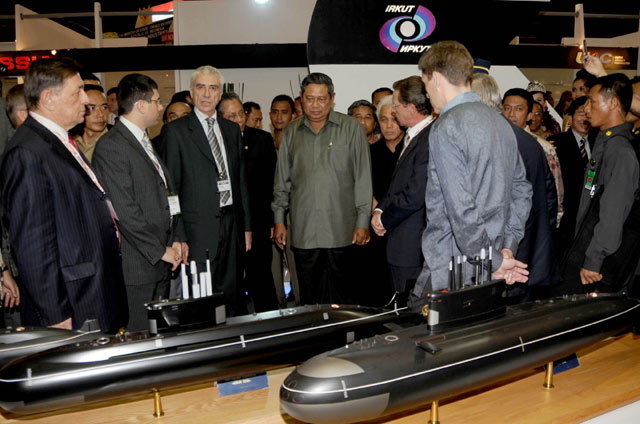
TSAMTO, VPK. Within the bigstep modernization of the Navy of the country, Vietnam has become one of the largest customers of Russian naval equipment. Cooperation is developing in all segments TDC - fighting surface ships of the main class, the boats of various types and SS.

In late 2009, Russia and Vietnam sign contract for supply of six diesel-electric submarines of Project 636 Kilo worth about 1.8 billion dollars. At the Admiralty Shipyard 26 August this year the ceremony of laying the first of six diesel-electric submarines of Project 636 Kilo, ordered the Navy in Vietnam. According to available data, diesel-electric submarines of Project 636 for the Navy in Viet Nam will be equipped with missile complex Club-S ".
Kilo 636 Vietnam will be equipped with Club S cruise missile, can reach 220km target (image : Novator)

Three months after signing the contract, the parties began negotiations on the construction of the item-based diesel-electric submarines and associated infrastructure. Financial parameters of the program experts estimate the sum, which is comparable or even greater than the cost of the diesel-electric submarines.

In the future, Vietnam expects to receive a loan from Russia for the construction of not only the locations of submarines, but also for the purchase of ships of various types (including rescue, supply vessels) and naval aircraft.

It should be noted that the submarine force and naval aviation will be new structures in the Armed Forces in Vietnam.

Molniya class missile boat, length 56,9m and full displacement 550ton (photo : Hoangsa)

The second largest project in the segment of TDC is the program delivery and licensed production of boats "Molniya", the total cost is estimated at $ 1 billion. In the 1990's. Vietnam was delivered four boats Project 1241RE Molniya rocket complex "Termite." In 1993, Vietnam has bought a license for the building of missile boats Project 1241.8 Molniya rocket complex "Uran." Supply of technical, regulatory and technological documentation for the construction of these ships began in 2005. From 2006 began the process of preparation for manufacture. According to the contract signed in 2003, two-boat project 1241.8 Molniya rocket complex "Uran" to be built in Russia and 10 boats on the Russian license in Vietnam. The first missile boat "Molnya" project 1241.8 rocket strike systems "Uran-E" was handed over to Vietnam in 2007, the second - in 2008. In 2010, with the laying of the first boats in the shipyard in Ho Chi Minh City, the start of the licensed part of the contract for construction of 10 boats, intended to last until 2016.

In the segment BNK OK with Vietnam implemented a major project to supply frigates. In 2006, Rosoboronexport signed with the Vietnamese Navy contract worth 350 million dollars to supply two frigates of Project 11661 “Gepard-3.9". Project developer is Zelenodolskoye PKB. Artist of the contract - OAO Zelenodolsky Shipyard.

Gepard class frigates, length 102m and displacement 2100ton (photo : shipspotting)

ZPKB proposed for Navy Vietnam upgraded version of Project 11661 “Gepard-3.9". It is based on the escort ship "Tatarstan", adopted by the arms of the Caspian Fleet of the Russian Navy.

Upgraded "Gepard" for Vietnam built by stealth. The ship is armed with antiaircraft complex "Palma-SU" with a new electro-optical guidance system and missile system "Uran".

Work to equip the frigates, the equipment are completed. Currently, two frigates of project 11661 “Gepard-3.9" tested in the Baltic. Then the ships will leave in Baltiisk, where they will transfer to the customer.

Project 11661 frigates are designed for searching, locating and destroying surface, underwater and air targets, either alone or in a group of ships. They can solve the escort and patrol tasks. Armament is two quad CP PKR Uran-E, 76-mm artillery shells of AK-176M, two 30-mm artillery AK-630M and 533-mm torpedo tubes. Displacement - 2100 tons, speed - 28 knots, the autonomy of the sea passage - 20 days. May be based on the frigate helicopters Ka-28 or Ka-31.

The Vietnamese side expressed its readiness to build under license by two more similar ships in the shipyards in Ho Chi Minh City (this option is not yet implemented).

Svetlyak class patrol boat, length 49m and displacement 390 ton (photo : ttvnol)


From Vietnam continues to implement the program delivery of patrol boats. In summer 2002, two patrol boats project 10412 Type "Svetlyak" ordered Navy Viet Nam, was launched at the shipyard "Almaz" (St. Petersburg). Both boats in January 2003 were transferred to the customer. The cost of each ship is from 10 to 15 million.

Is constructed on the basis of a contract signed with the Vietnamese side Rosoboronexport in November 2001. Boats of the "Svetlyak" are intended to protect the maritime border, coastal communications and combat poachers. In the armed ship - two artillery of the AK-306, a system for combating air targets Igla-1M.

At the same time Viet Nam expressed his intention to continue the construction program for the national Navy boats of the "Svetlyak" (as a whole dealt with the construction of a series of 10-12 patrol boats of this type). This program was further developed in 2009. In the summer of 2009 by two Russian shipyards (shipbuilding company Almaz shipyard and the East Wharf "in Vladivostok) was laid in a total of four patrol boats project 10412 "Svetlyak"(2 on each boat), commissioned by the Ministry of Defense of Vietnam.

TFR Project 10412 was developed in St. Petersburg JSC "Central Marine Design Bureau Almaz. Cutters have high seaworthiness, speed - 30 knots. On board mounted gun, anti-aircraft guns. Crew - 28 people.

Shipbuilding company Almaz was planning to pass two boats to the customer before the end of 2010. Terms of delivery vehicles "Eastern shipyard has not been reported.


K300P Bastion land based anti ship missile, can reach 300 km target (photo : ttvnol)
Until the end of this year, Vietnam will also send mobile coastal missile system (MSMC) K-300P "Bastion-P". Vietnam became the first customer "Bastion", signed in 2006 a contract to supply two sets of MSMC.

In January 2002, JSC "Kronstadt" has set for the Navy in Viet Nam first full-scale simulator "Tarantul I” 1241RE. With the help of marine simulator "Tarantul I", staged in 2002, the Vietnamese sailors practiced management skills 1241RE missile boats of the project with a set of "Termite", set in 1990.

Cooperation with Vietnam on naval simulators has been further developed. Vietnam expressed his intention to purchase an integrated simulator for the three types of ships - Project 1241RE, Project 1241.8 frigates procured and Gepard.
Tarantul I class, length 56m and displacement 590 ton (photo : Militaryphotos)

Rosoboronexport, in September 2006 signed a contract with the Navy in Viet Nam to upgrade treadmill "Tarantul I” 1241RE and delivery of new simulators for missile launches and projects 1241RE 1241.8 Molniya. The delivery was implemented in December 2007.

Apart from Russia, Vietnam is actively cooperating in the field of TDC with India, which is its strategic ally in the region.

In March 2002, Vietnam and India have signed an agreement on cooperation in the field of rehabilitation, modernization and construction of fast patrol boats, as well as training technical personnel, including divers. Several times India has assisted in the delivery of spare parts for ships, which are overwhelmingly produced in the USSR and Russia.


(VPK)

TNI AL Tingkatkan Patroli Paca Penyiksaan 4 WNI


0diggsdigg

illustrasi

TRIBUNNEWS.COM, NUNUKAN - TNI Angkatan Laut meningkatkan intensitas patroli pasca penyiksaan Tentara Diraja Malaysia (TDM) terhadap empat warga negara Indonesia (WNI) di sekitar pos sekacara, Muara Sungai Sebuku, Senin (15/11/2010).

Komandan Pengkalan TNI Angkatan Laut Nunukan Letkol Laut (P) Rachmad Jayadi mengatakan, meskipun para korban tidak melaporkan kasus itu ke Pangkalan Angkatan Laut Nunukan, namun pihaknya tetap menindaklanjutinya dengan menggelar patroli di sekitar kawasan dimaksud.

"Semua laporannya masuk ke Satgas Pengamanan Perbatasan. Pos Sekaca itu Satgas Pamtas TNI AD bukan Pos TNI AL. Dari awal di sana sudah ditempati Satgas Pamtas. Saya cuma dapat informasi saja dan informasi itu saya tindaklanjuti dengan patroli," ujarnya.

Rachmad mengatakan, intensitas peningkatan patroli tersebut termasuk dilakukan pada malam hari. "Kita jarang keluar patroli malam. Padahal waktu itu kejadiannya malam. Jadi waktu dia mincing dia sudah masuk wilayah Indonesia atau sudah keluar, itu kita tidak tahu. Kita sekarang patroli malam jangan sampai ada lagi seperti itu," ujarnya.

Pada kesempatan itu, ia juga menghimbau agar warga Nunukan tidak terlalu jauh memancing di daerah perbatasan. "Kita punya banyak ikan, ngapain ke sana? Mereka loh sering nyuri di tempat kita," katanya.

Seperti diberitakan sebelumnya empat WNI di Nunukan, Senin (15/11/2010) lalu diduga telah disiksa Tentara Diraja Malaysia (TDM). Menurut pengakuan korban mereka ditangkap di perairan Indonesia lalu digiring ke perairan Malaysia, selanjutnya mendapatkan penyiksaan. Selain ditampar, para WNI tersebut juga dipaksa pulang berenang ke Indonesia.

Sumber: TRIBUN

DPR Dukung Kajian Hibah F-16 dari AS dan Pesawat Hibah dari AS Masih Dipertimbangkan


F-16 Fighting Falcon USAF dari 8th Fighter Wing, Kunsan Air Base, South Korea. (Foto: U.S. Air Force/Capt. Shannon Collins)

18 November 2010, Jakarta -- Anggota Komisi I DPR RI Nurhayati Ali Assegaf mengatakan bahwa Komisi I akan mendukung apa pun kajian pemerintah terkait dengan hibah atau bantuan pesawat F-16 dari Amerika Serikat.

"Komisi I akan dukung upaya pemerintah untuk melakukan kajian terkait hibah tersebut, apa pun keputusan pemerintah nantinya," kata Nurhayati di Jakarta, Kamis.

Menurut dia, pemerintah tentu punya pertimbangan matang dalam persoalan tersebut.

"Kalau dari hasil kajian, pemerintah mengatakan bantuan itu tidak pantas diterima, kita (Komisi I) juga akan terima (sikap itu)," kata Nurhayati.

Nurhayati mengingatkan bahwa upaya mengkaji hibah F-16 itu jangan sampai membebani negara.

"Bantuan apa pun kalau tidak kita perlukan buat apa. Hibah atau bantuan, kalau memang kita butuhkan, kita akan terima dengan senang hati. Tapi kalau ada keinginan pemerintah untuk mengkaji, tak masalah. Jangan sampai bantuan akhirnya membebani kita. Kalau kita punya anggaran, ya kita beli baru saja," kata Wakil Ketua Badan Kerjasama Antar Parlemen DPR itu.

Memang diakui adanya pemikiran yang berkembang, apakah Indonesia membutuhkan pesawat tempur atau pesawat angkut untuk misi kemanusiaan, terutama ketika menghadapi bencana.

Masyarakat dunia sudah mengetahui bahwa Indonesia adalah garis terdepan dari perubahan iklim serta memiliki daerah yang luas sehingga dibutuhkan peralatan perang yang memadai.

"Memang ada pemikiran bahwa alat utama sistem persenjataan ini juga harus dipersiapkan untuk menjaga keamanan wilayah NKRI untuk melindungi rakyatnya. Tapi ketika bencana juga bisa difungsikan," kata Nurhayati.

Bantuan Mentawai

Sementara terkait tawaran dari negara lain seperti China untuk membantu korban bencana Mentawai, Nurhayati mengatakan, bantuan asing tersebut bisa diterima asalkan pengelolaannya dilakukan oleh pemerintah Indonesia.

"Kalau asing cepat sekali untuk memberikan bantuan itu dan langsung datang. Tapi apakah kita siap? Lebih baik kita atasi sendiri, oleh pemerintah sendiri. Kalau untuk Mentawai tidak perlu dulu lah karena ini beda dengan Aceh," ujarnya.

ANTARA News


F-16A/B TNI AU. (Foto: Dispenau)

18 November 2010, Jakarta -- Rencana hibah 24 unit pesawat tempur F-16 dari Amerika Serikat untuk memperkuat skuadron pertahanan udara Indonesia masih dipertimbangkan. Kementerian Pertahanan masih mempelajari untung ruginya dibanding membeli pesawat baru. "Plus minusnya itu yang sedang kita kaji secara cermat," kata Menteri Pertahanan Purnomo Yusgiantoro di Jakarta, Rabu (17/11).

Harga sebuah pesawat F-16 baru yakni US$ 70 juta. Sedangkan biaya untuk meng-upgrade atau menaikkan kemampuan pesawat hibah setiap pesawat dibutuhkan berkisar US$ 5 juta hingga US$ 7 juta.

Tim teknis Kementerian Pertahanan saat ini berada di AS melihat kondisi fisik pesawat. Mereka juga mengalkulasi angka perbandingan untuk menerima hibah dengan segala konsekuensinya atau membeli pesawat tempur

Liputan6

BERITA POLULER